Digitalization of Study Plan Cards (KRS) Brings New Convenience to Students
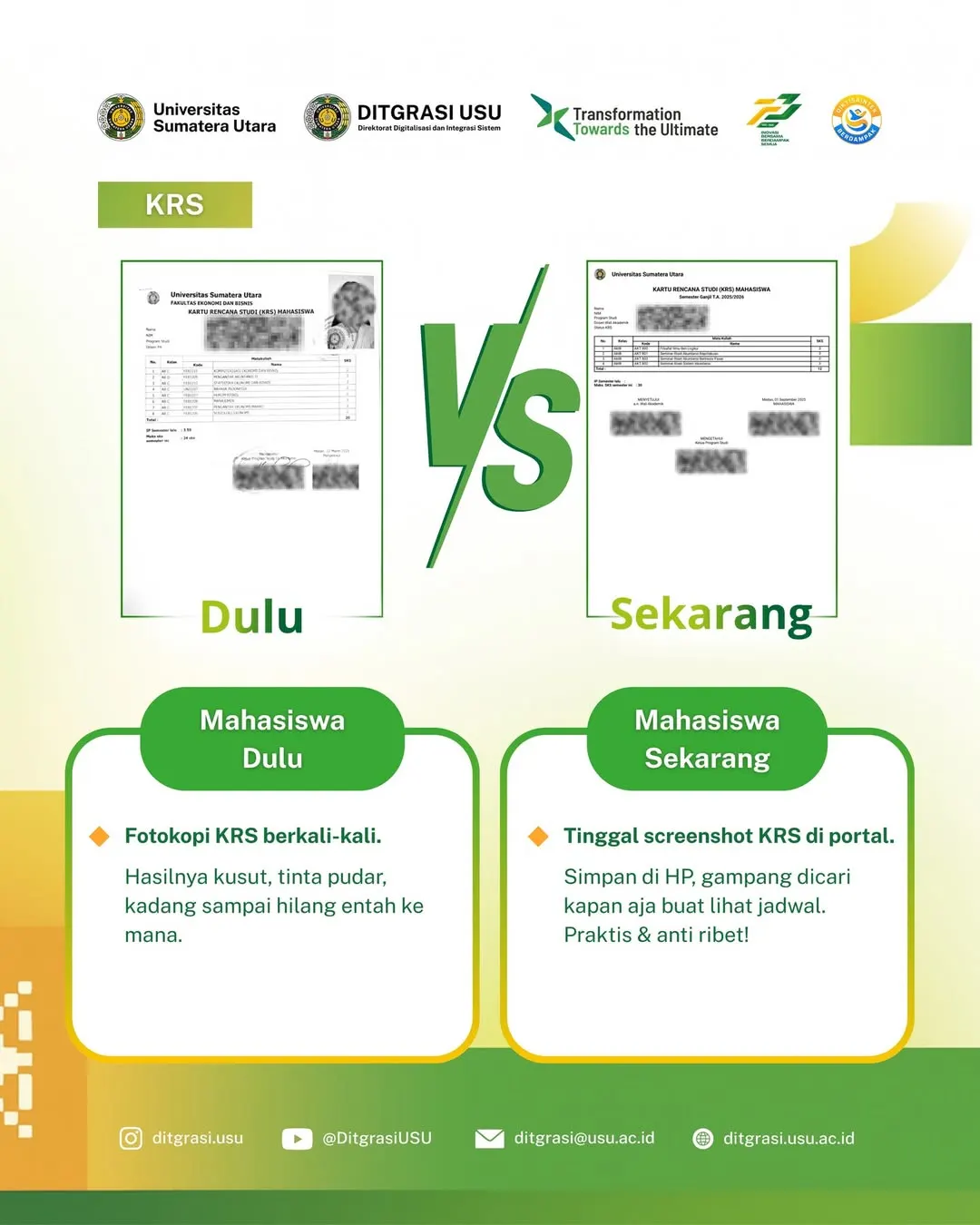
The “KRS Then vs. Now” comparison photo released by DITGRASI USU illustrates significant changes in the governance of academic documents, which have long been an important part of student lecture activities.
Article
Universitas Sumatera Utara (USU) continues to strengthen its commitment to realizing academic services that are more modern, efficient, and responsive to the needs of the academic community. Through the digital transformation program managed by DITGRASI USU, the academic administration process is now easier thanks to the implementation of an integrated digital system, one of which is the management of the Study Plan Card (KRS).
The “KRS Then vs. Now” comparison photo released by DITGRASI USU illustrates significant changes in the governance of academic documents, which have long been an important part of student lecture activities.
KRS Then: Relying on Paper, Prone to Damage and Loss In the previous system, students had to print or photocopy their KRS multiple times for administrative needs. This caused several issues:
- Paper easily wrinkles, tears, or fades because it is often stored in bags.
- Ink fades quickly, especially if printed using old photocopiers.
- Documents are easily lost, requiring students to reprint them.
- Only available in physical form, making storage and retrieval impractical.
These conditions often posed challenges when students needed their KRS unexpectedly, such as when checking class schedules, filling out administrative forms, or verifying academic data.
KRS Now: Digital, Practical, and Secure Through the increasingly mature USU academic portal system, students can now view and download KRS directly via the official platform. No longer requiring paper or photocopies, the digital KRS can be easily stored on a mobile phone or laptop.
Students simply need to:
- Login to the portal.
- Open the KRS page.
- Screenshot or download the file for digital storage.
In this way, the KRS is safer, will not crumple or get lost, and can be found quickly whenever students need it. This convenience also supports efficiency in scheduling lectures and handling other administrative needs.
The digitalization of KRS is not merely a technical change, but a representation of a shift in work culture and learning styles within the USU environment. Students are now encouraged to become accustomed to managing academic documents digitally, utilizing technology to support lecture activities, and preparing to face the dynamics of the ever-evolving digital era.